Bullion Horizon for cTrader: a gold grid on the H1 confluence signal
Every hour, on the closed bar, four readings are scored - trend, RSI, cycle and price action - and a signal needs enough of them to agree. As shipped the signal opens a grid: a first ticket, then a larger one every 500 points against the move, up to eight per side, all closed together at a fixed basket profit. Eight configurations are built in, two of them single-ticket with a hard stop and target, and a dashboard on the chart shows every state. The C# engine was transcribed from the original function by function and checked trade by trade on identical bars.
cTrader 5.x · C# on the cAlgo API · 67 parameters: the 63 of the original plus 4 cTrader-only · AccessRights = None · 147 USD once on the cTrader Store, 14-day money back
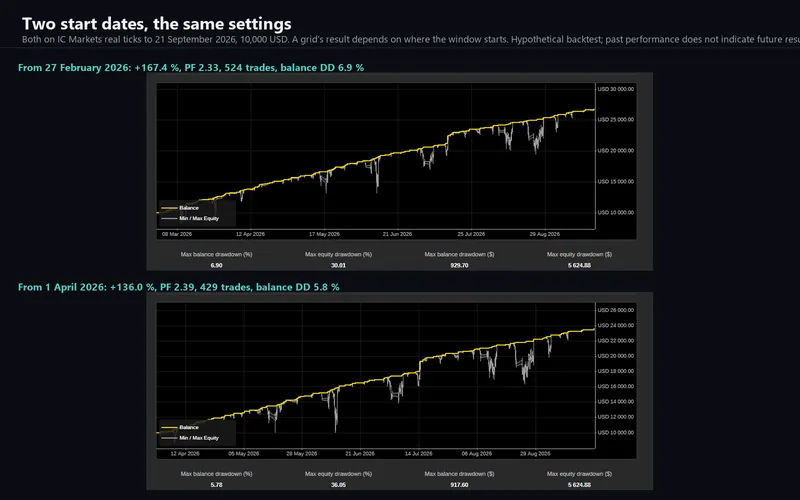
cTrader's own backtester on IC Markets real tick data, XAUUSD H1, 10,000 USD, leverage 1:100, commission 27.5 USD per million, 27 February to 21 September 2026, the shipped configuration. Every figure is read from the run's own report file. Hypothetical results of a backtest; past performance does not indicate future results.
Running in public since 25 Sep 2026
The cTrader cBot runs on a Blueberry Markets demo account: $10,000 at the start, no deposits since, never reset. Preset: Gold Grid Default, the shipped default. 18 days of history is a start, not a verdict.
Demo account. Figures from the Myfxbook API on ; the Myfxbook page always shows today's.
The Bullion Horizon gallery, picture by picture
The 11 pictures of the cTrader Store gallery. Select any picture to open it full size.


What it does
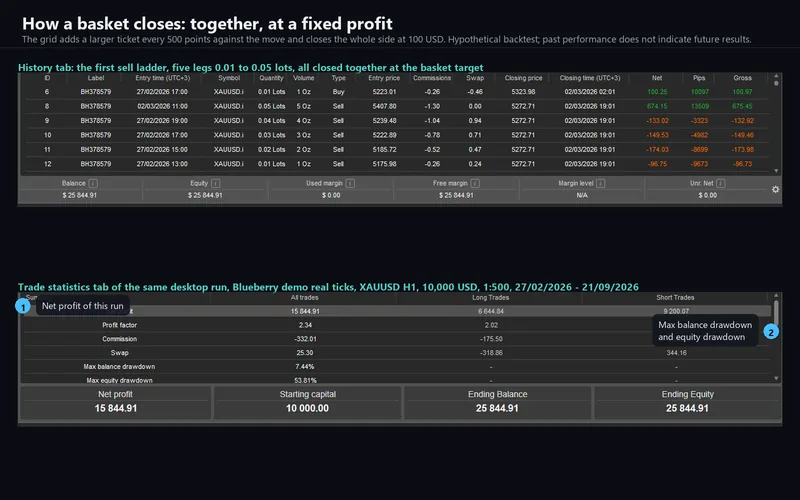
Bullion Horizon trades gold on the H1 chart. Every hour, on the closed bar, it scores four readings - the trend (close above the 20-bar average, which is above the 50-bar average, or the mirror for sells), the RSI against its oversold and overbought levels, the cycle (the close against the close twenty bars back) and price action (higher highs with higher lows, or the reverse) - and only acts when the sum reaches the minimum confluence score. As shipped it runs a grid: the first ticket opens on the signal at 0.01 lot, every 500 points against the move another ticket is added, each 0.01 lot larger than the last, up to eight per side, and the whole side is closed together when its open profit reaches 100 USD. Two single-ticket presets with a hard stop and a hard target are built in for anyone who wants no grid at all.
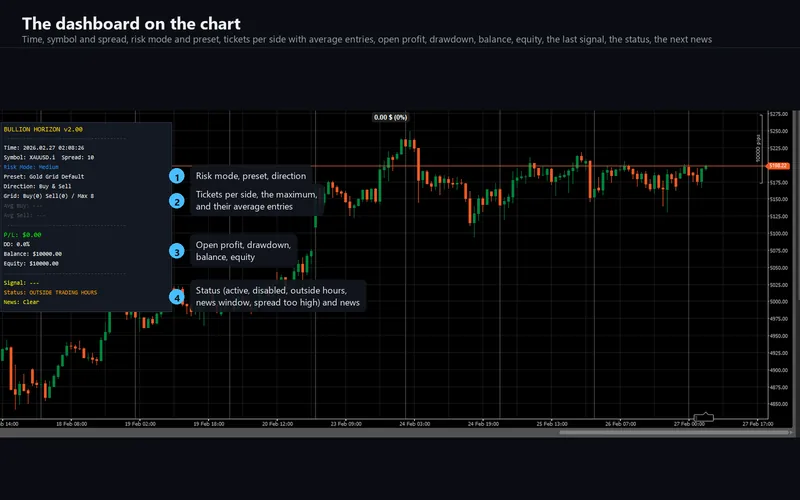
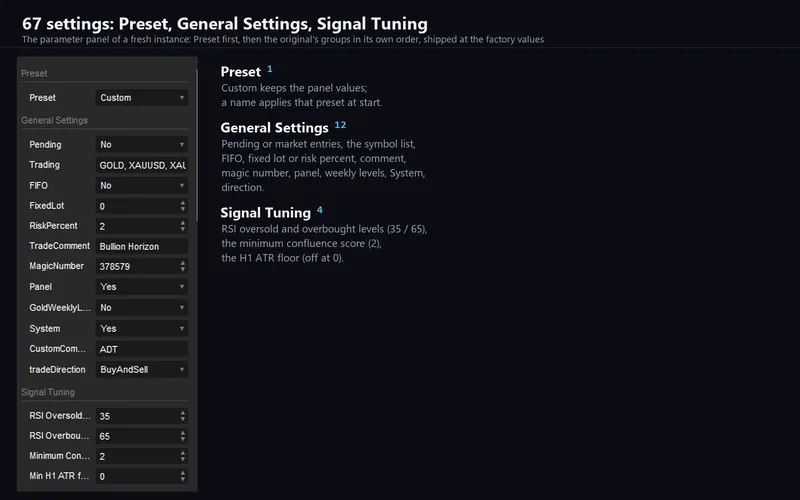
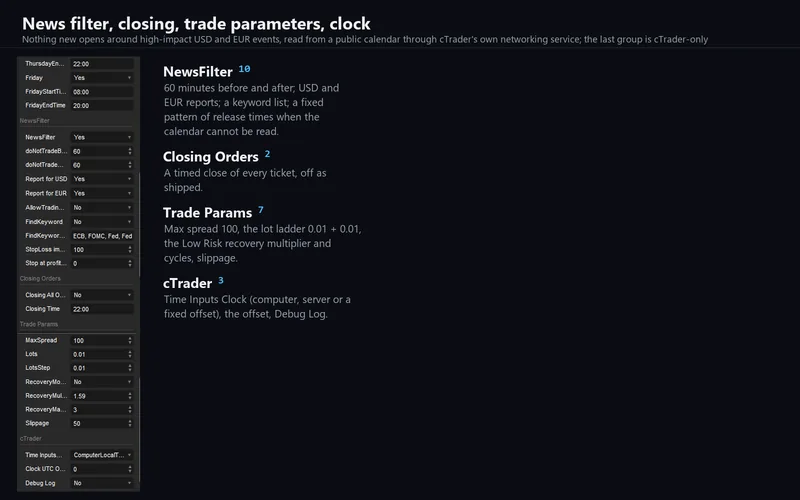
The panel's defaults are the factory values - the same configuration the author runs on his own demo account - and the first parameter, Preset, switches the whole set to one of eight named configurations without loading a file. A dashboard on the chart shows the time, symbol and spread, the risk mode and the preset in use, tickets per side with their average entries, open profit, drawdown, balance and equity, the last signal with its four scores, the status and the next news event. With the news filter on, nothing new is opened from 60 minutes before to 60 minutes after a high-impact USD or EUR event, read from a public economic calendar through cTrader's own networking service; each weekday has its own trading window, in the clock you choose.
The published backtest
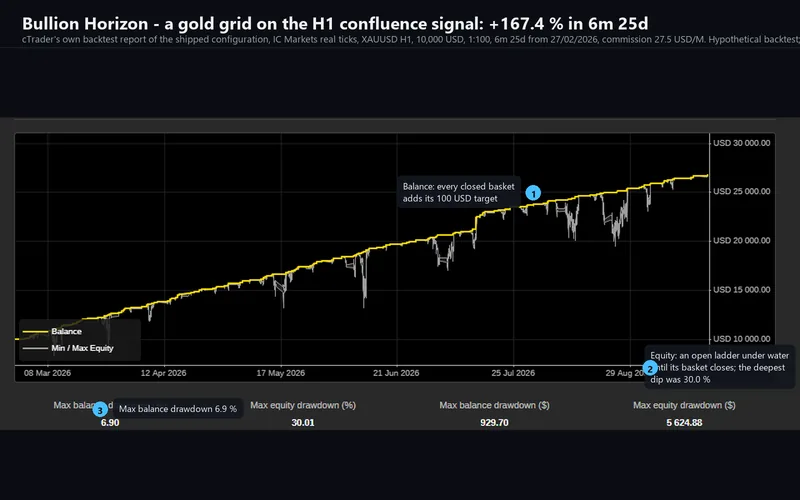
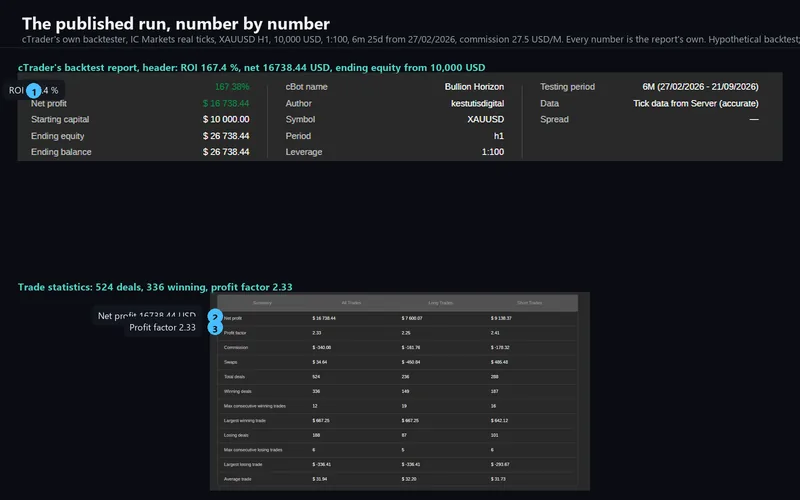
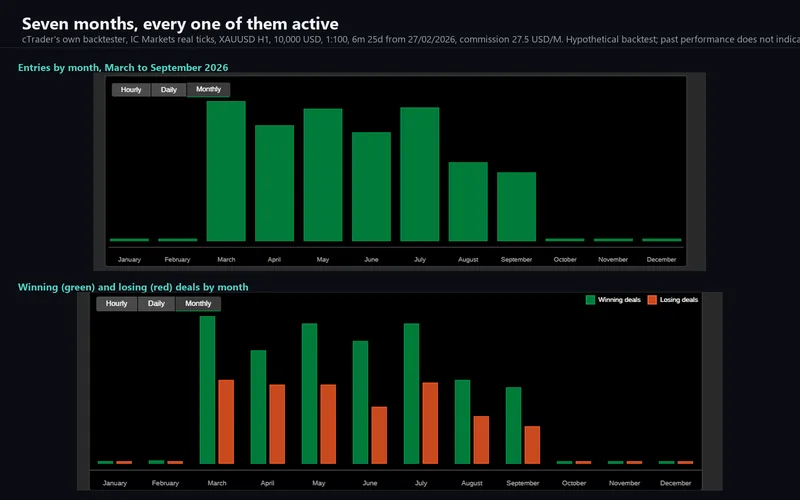
The figures on this page are cTrader's own backtest report of the shipped configuration, run by cTrader's backtester on IC Markets real tick data, XAUUSD H1, 10,000 USD, leverage 1:100, commission 27.5 USD per million USD of volume, from 27 February 2026 to 21 September 2026. Every number is read from the run's own report file: net profit 16,738.44 USD, a return of 167.4 %, profit factor 2.33, 524 trades of which 336 won, a maximum balance drawdown of 6.9 % and a maximum equity drawdown of 30.0 %. The same window on Blueberry Markets' real ticks at 1:500 gave 158.4 % with a profit factor of 2.34 and an equity drawdown of 53.8 % - the same trades, a different depth of open ladder, because spreads, swaps and tick timing differ by broker. Started on 1 April 2026 instead, the IC Markets run gave 136.0 %.
What that backtest cannot promise. A grid without a basket stop carries every open ladder until the basket target is reached. In a strong move against the ladder the floating loss grows with every ticket, and with enough tickets and leverage it reaches the margin call: this configuration did exactly that on both platforms' testers when started on 1 January 2026, three weeks before the published window begins, on the January gold rally. The result of any run depends on its start date, broker data, balance and leverage. Run your own backtest on your own broker's data before trading, set the basket stop to your own tolerance, and size the balance so that the equity drawdown shown above is affordable - three times it is the recommended minimum.
How the port was verified
The engine is platform-free C#: it references no cTrader type, so the code that ships can be compiled outside the platform and replayed against a bar series. Its signal layer was compared with the original's own indicator values and scores on every closed hour of the available history, with zero mismatches, and its trade decisions were compared on identical bars, trade by trade, to the cent. The cTrader edition was then run in cTrader's own backtester on real ticks, and its desktop Backtesting tab and the command-line backtester agreed to the cent on the same window. The release build and the development build produce the same trade list.
Presets
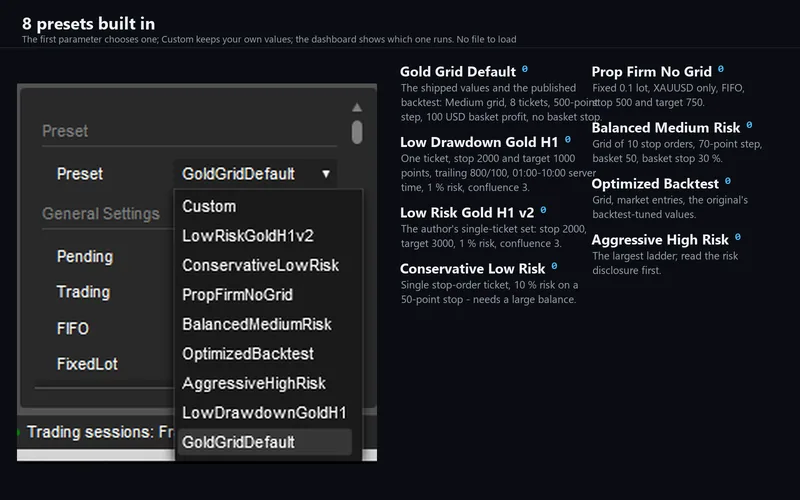
Eight configurations are built into the cBot and chosen with the first parameter: Gold Grid Default (the shipped values), Low Drawdown Gold H1 (one ticket, stop 2000 and target 1000 points, trailing stop, a 01:00-10:00 server-time window), Low Risk Gold H1 v2 (the author's single-ticket set), Conservative Low Risk, Prop Firm No Grid, Balanced Medium Risk, Optimized Backtest and Aggressive High Risk. Custom keeps whatever the panel shows. All eight live inside the cBot - the first setting applies one at start and the dashboard's Preset row shows which is running - so there is no file to download, find or import after the purchase.
Requirements
cTrader Desktop 5.x on Windows or Mac, a hedging account, leverage 1:100 or higher, XAUUSD or your broker's spelling of it, the H1 chart. Sixty-seven parameters: the sixty-three of the original plus Preset, the clock source, the clock offset and a debug log. It declares no access rights at all; the news calendar is read through cTrader's own networking service, which is why it needs none. Keep the platform running, or use a VPS.
Support
Through the Discussion tab of the Store listing, so the conversation stays next to the product. Please include your broker, cTrader version, the preset in use and the instance log.
This is trading software that places, modifies and closes orders on the account it runs on. A grid adds to a losing side and, without a basket stop, can lose the whole balance in a strong move against it; the January 2026 gold rally did exactly that in both platforms' testers. Backtest results are hypothetical; past performance does not indicate future results. Trading leveraged products involves risk of loss.