cTrader cBot
Bullion Horizon
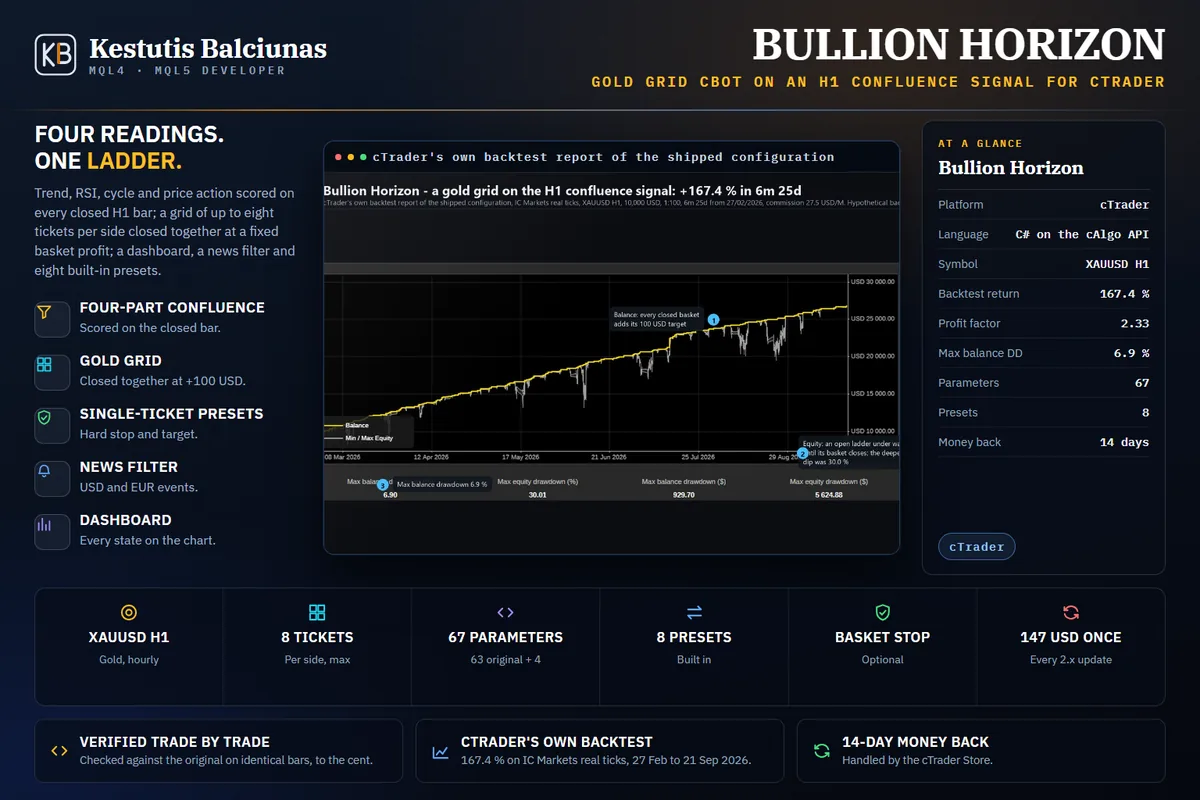
A gold grid on an H1 confluence signal: four readings must agree, then a ladder of tickets is closed together at a fixed basket profit.
How it was builtLive on Myfxbook since 25 Sep 2026 (demo)A funded account is not a small account with a bigger balance: it is an account with two loss limits, a restricted-strategies list and a reset clock. This page is what every one of those rulebooks counts, what to ask of any robot before it trades an evaluation, and the cBots listed on the cTrader Store - each with the preset it needs and the drawdown that preset actually measured.
Every card links to its own Store listing and to its documentation. The block under each one says what it takes to run it inside a firm's limits.
Nothing matches that filter.
A gold grid on an H1 confluence signal: four readings must agree, then a ladder of tickets is closed together at a fixed basket profit.
How it was builtLive on Myfxbook since 25 Sep 2026 (demo)
A buy-only gold grid on XAUUSD M5: a deep RSI dip opens a buy, one more may follow lower, and both close together just above break-even.
How it was builtLive on Myfxbook since 28 Sep 2026 (demo)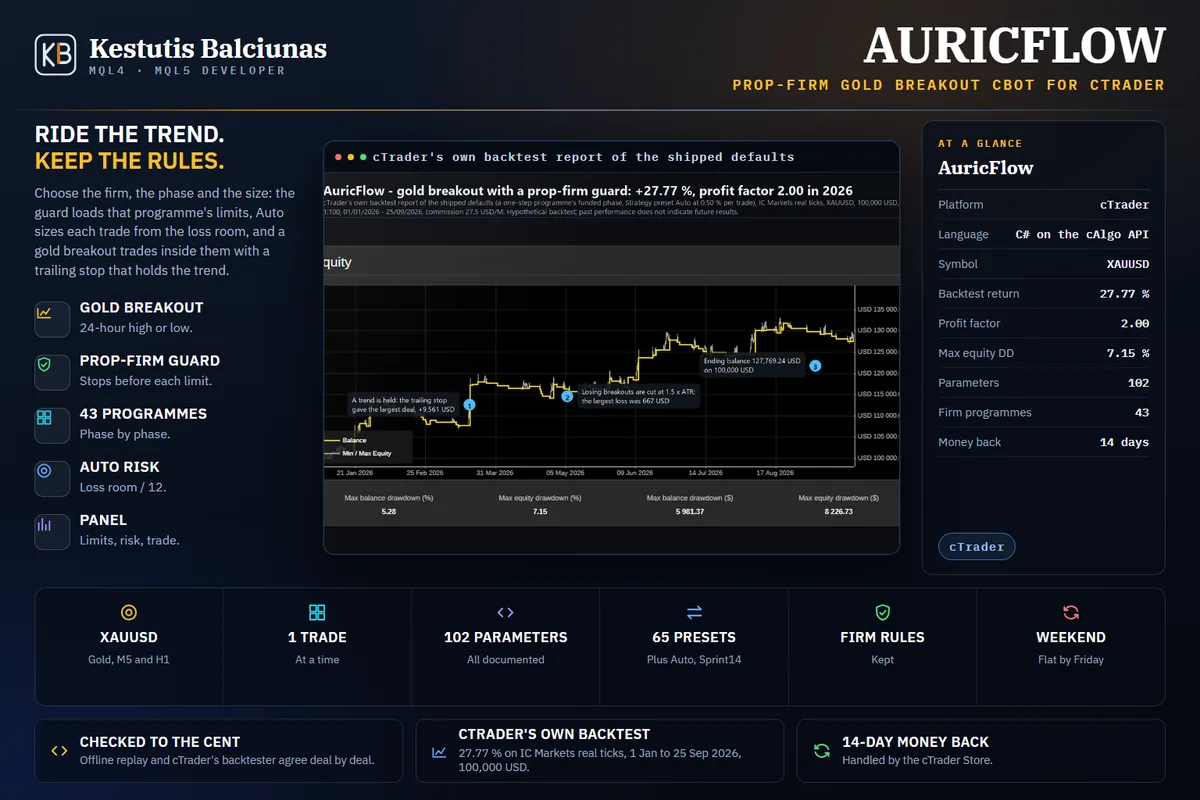
A prop-firm gold breakout cBot: risk set from your firm's loss room, the stop with the broker, a trailing stop that holds the trend.
How it was builtLive on Myfxbook since 28 Sep 2026 (demo)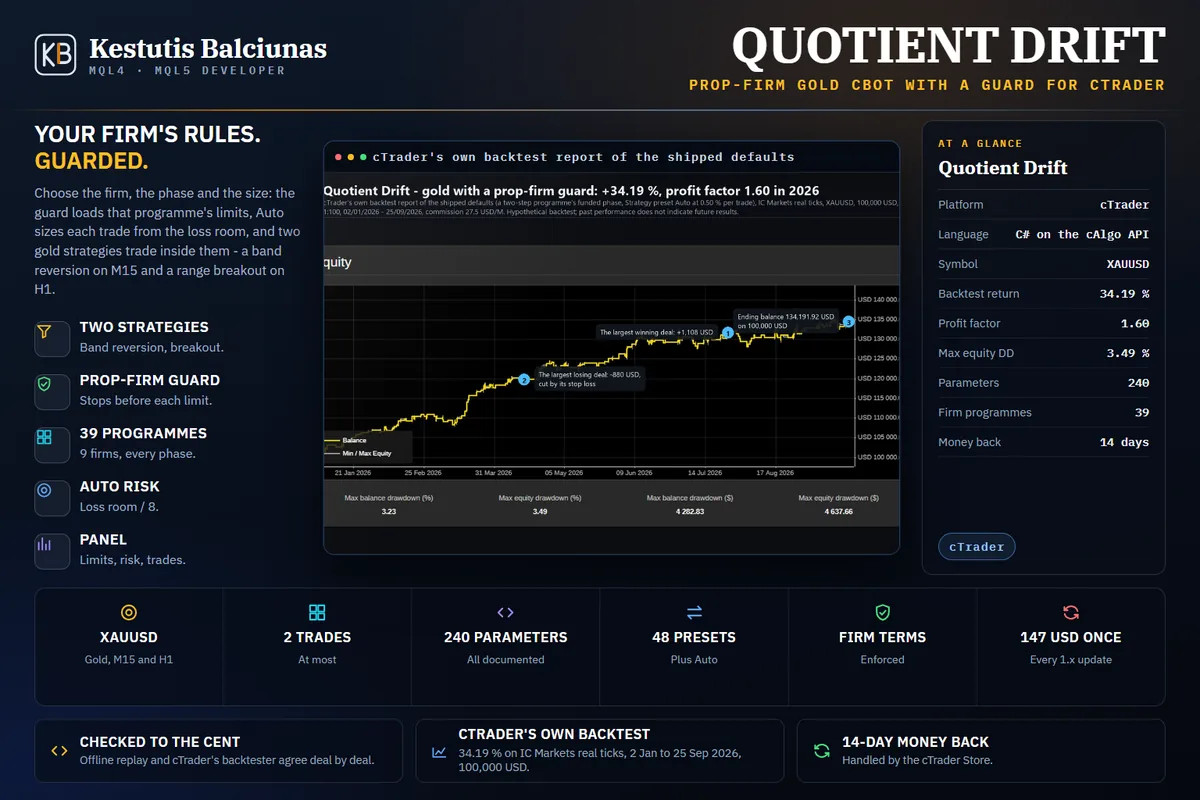
A prop-firm gold cBot: band reversion on M15 and a range breakout on H1, risk sized from your firm's loss room, the firm's limits and robot terms kept.
How it was builtLive on Myfxbook since 29 Sep 2026 (demo)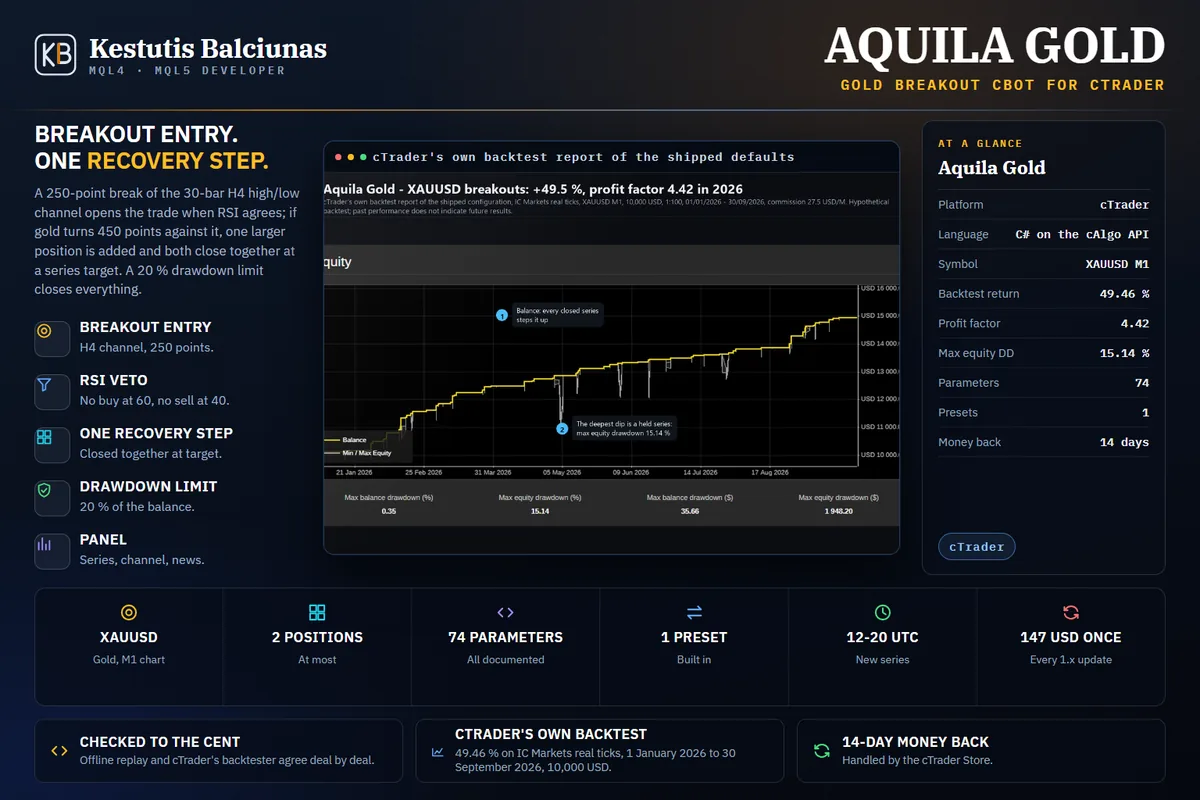
A gold breakout cBot on XAUUSD M1: a break of the H4 high/low channel opens the trade, one larger recovery position at most, both closed together at a series target.
How it was builtLive on Myfxbook since 2 Oct 2026 (demo)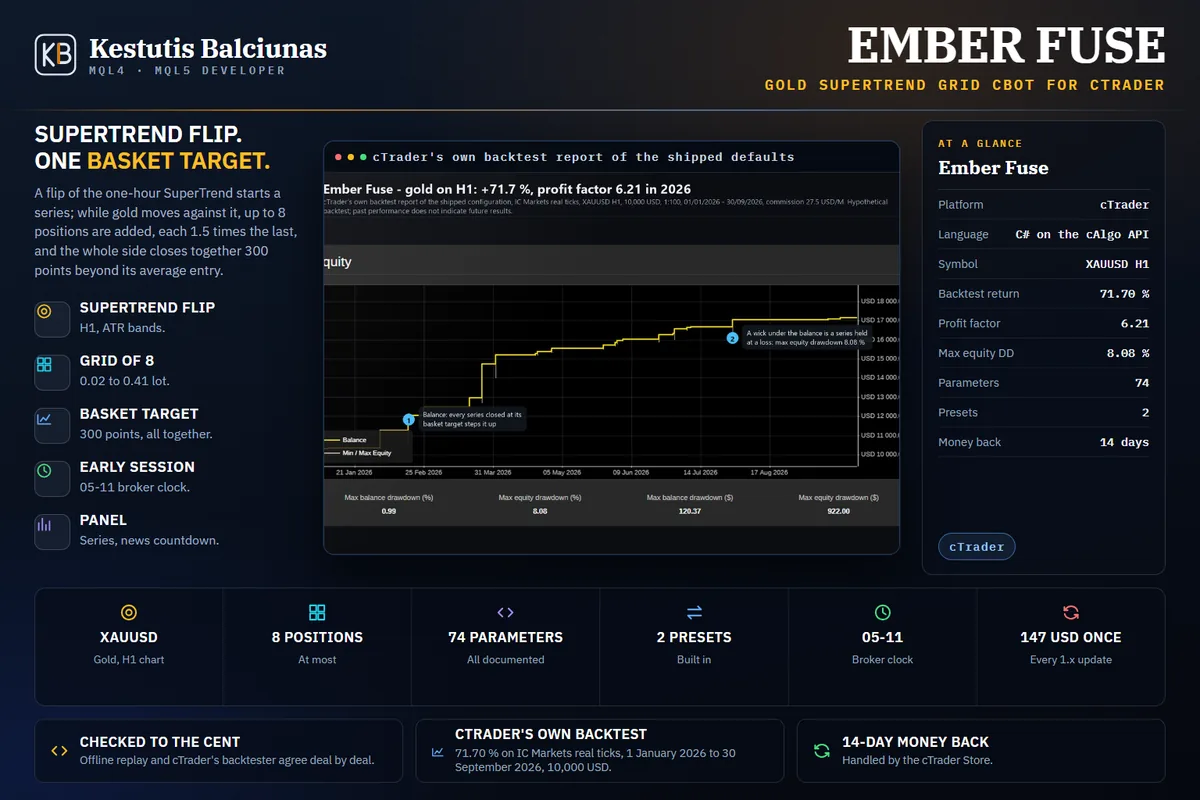
A gold cBot on XAUUSD H1: a SuperTrend flip starts a series, a grid of up to 8 positions closes together at one basket target, new positions only in the early session.
How it was builtLive on Myfxbook since 2 Oct 2026 (demo)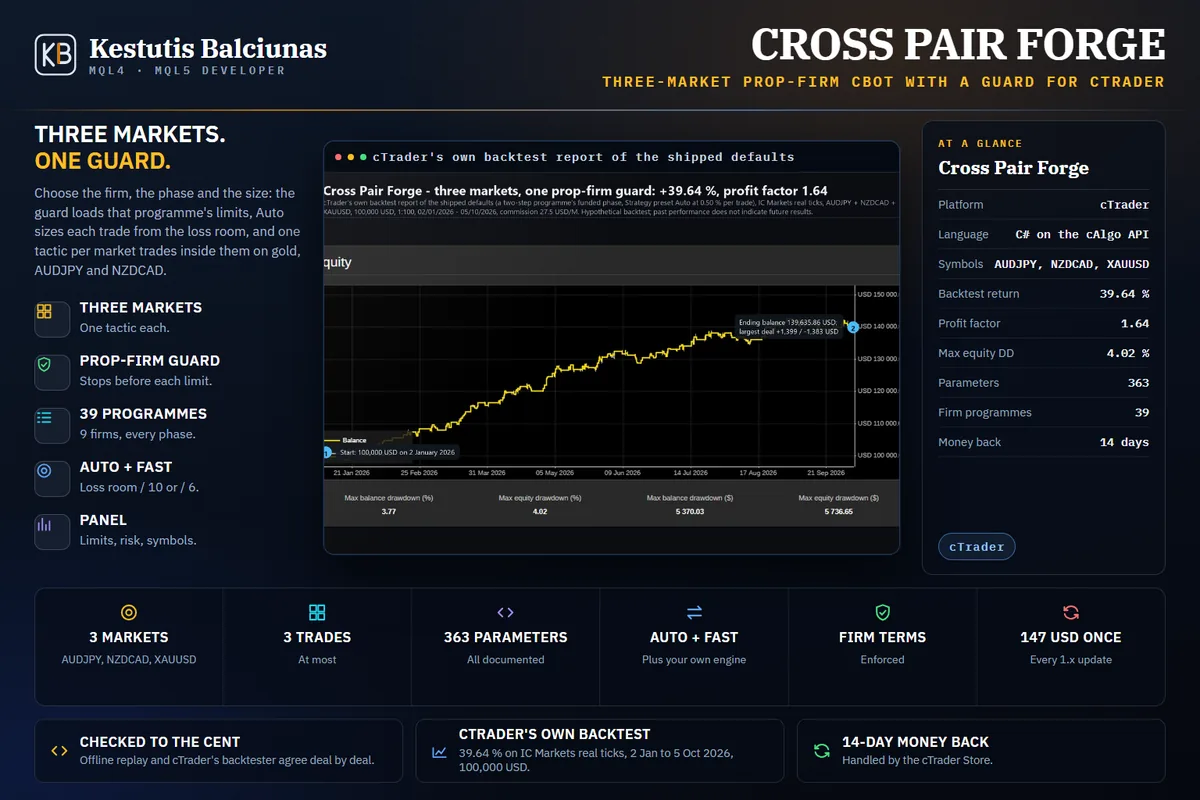
A prop-firm cBot trading AUDJPY, NZDCAD and gold from one chart: one tactic per market, risk sized from your firm's loss room, the firm's limits and robot terms kept.
How it was builtLive on Myfxbook since 11 Oct 2026 (demo)More cBots are in development; each will be listed here, with its own prop-firm page, once it is approved on the Store.
As shipped it is a grid - up to eight tickets a side, closed together at a basket target - and its published run reached a 30.0 % equity drawdown. That configuration is not built for prop-firm limits, and its Store trading profile says so.
Its Low Drawdown Gold H1 preset is the one to look at: one ticket at a time, a hard stop and target, a 01:00 to 10:00 window, and a worst maximum equity drawdown of 8.7 % with a worst single day of 2.8 % across six backtest runs over three windows. The preset is inside the cBot, chosen from the first setting.
Rulebooks differ in wording, rarely in shape. Almost all of them count the same four things, and only the first three are under a robot's control.
| What is counted | What it means for a cBot |
|---|---|
| A daily loss limit | Measured from balance or equity at the firm's own reset clock, not your broker's. A cBot needs a timed close and a session window that sit inside that day. |
| A total loss limit | Usually measured on equity, so open positions count against it. Floating loss is the number that ends accounts, not realised loss. |
| A restricted-strategies list | Grids, martingale, hedging between accounts, latency and news scalping. Read it before you choose a configuration, not after. |
| A profit target, minimum days, consistency | Nothing a robot can promise. It can stop once a target is reached; it cannot make the market provide one. |
That is why the pages below lead with a drawdown figure rather than a return. A return tells you what a configuration made on data that has already happened. The drawdown tells you whether the account would still have been open at the end of it.
Every firm's cTrader account is a live broker feed with its own spreads, its own commission and its own server clock, and a configuration that behaved on one broker's ticks can behave differently on another's. Run the backtester on the account you were given, at that account's balance and leverage and with that broker's commission, over a window you did not choose for its result. Then read the equity drawdown and the worst single day before you read anything else.
Two things no backtester can do: it cannot apply a news filter, because it carries no economic calendar, and it always runs on server time. Both make a backtest slightly more active than the live configuration, not less.
None of these cBots carries a rule guard. The Expert Advisors for MT4 and MT5 do - a guard that takes a firm's numbers from a dropdown and decides when the EA must stop - but on cTrader the limits are yours to set, from the controls each product's page lists by name. Nothing here knows that your firm changed a limit last week, and nothing here can make an evaluation finish faster than the market allows. Your firm's dashboard is the authority on its own numbers, and a backtest is a record of the past, not a prediction.
The MT4 and MT5 Expert Advisors carry a prop-firm rule guard that takes a firm's numbers from a dropdown and decides when the EA must stop. Among the cBots, AuricFlow, Quotient Drift and Cross Pair Forge carry the same kind of guard; the grid cBots do not, which is why this page hands you the controls for those instead.
If you need a cBot built to one firm's rulebook, that is custom work: send the firm, the programme and the rules, and the specification comes back before anything is paid.