Quotient Drift for cTrader: gold with a prop-firm guard
Choose your firm's programme, the phase and the account size: the guard loads that programme's limits, the strategy sizes every trade from the room they leave, and the robot stops before a limit is reached. Two strategies run on gold - a band reversion on 15-minute bars and a range breakout on hourly bars - with at most two trades open, every stop with the broker, and the firm's own robot terms enforced where it has them.
cTrader 5.x · C# on the cAlgo API · 240 parameters · hedging account · AccessRights = None · 147 USD once on the cTrader Store, 14-day money back
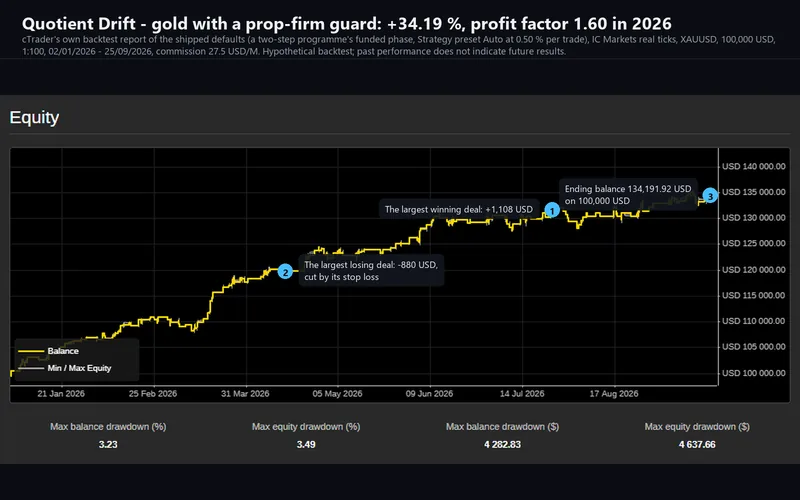
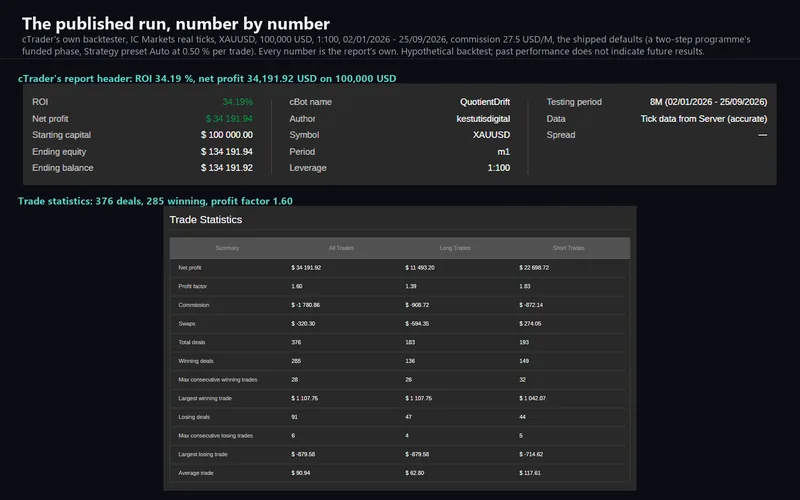
cTrader's own backtester on IC Markets real tick data, XAUUSD, 100,000 USD, leverage 1:100, commission 27.5 USD per million, 2 January to 25 September 2026, the shipped defaults (a two-step programme's funded phase, Strategy preset Auto at 0.50 % per trade). Every figure is read from the run's own report file. Hypothetical results of a backtest; past performance does not indicate future results.
Running in public since 29 Sep 2026
The cTrader cBot runs on a Blueberry Markets demo account: $10,000 at the start, no deposits since, never reset. Preset: the shipped defaults, funded stage at 0.50 % risk per trade. 14 days of history is a start, not a verdict.
Demo account. Figures from the Myfxbook API on ; the Myfxbook page always shows today's.
The Quotient Drift gallery, picture by picture
The 11 pictures of the cTrader Store gallery. Select any picture to open it full size.
What it does
Quotient Drift trades gold with a prop-firm guard built in. You choose your firm's programme, the phase and the account size; the guard loads that programme's limits, the strategy sizes every trade from them, and the robot stops before a limit is reached. Two strategies run side by side on XAUUSD, at most two trades open at a time. A band reversion on 15-minute bars buys a close at or below the lower Bollinger band (20 periods, 2 deviations) and sells a close at or above the upper band, only while the four-hour ADX is at most 35 and never against the four-hour trend. A range breakout on hourly bars buys an hourly close above the highest high of the 96 hourly candles before it, and sells a close below their lowest low, only while the four-hour ADX is at least 25. Each trade gets its stop loss and take profit with the broker right after the fill, sized from the hourly ATR; half of the position closes at one times its risk, the stop then moves to break-even, and a trailing stop follows the rest. There is no grid, no martingale and no averaging down.
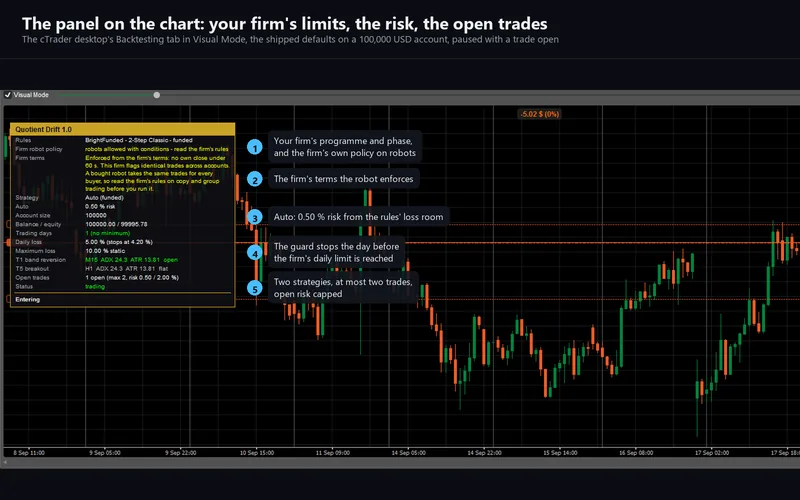
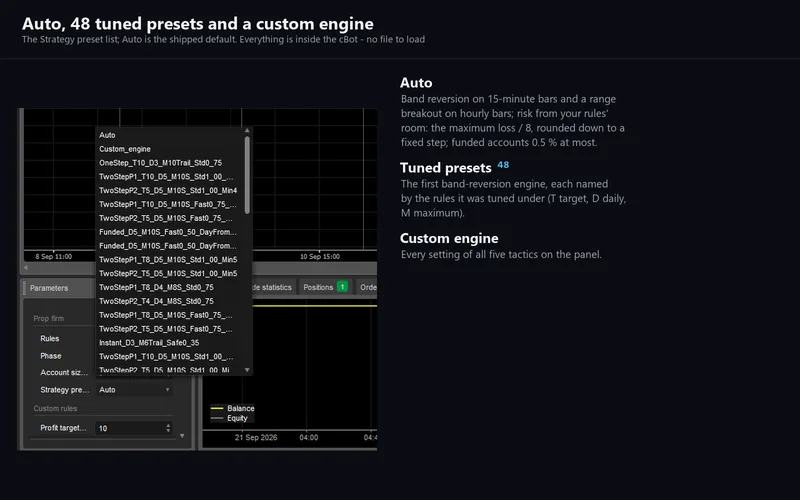
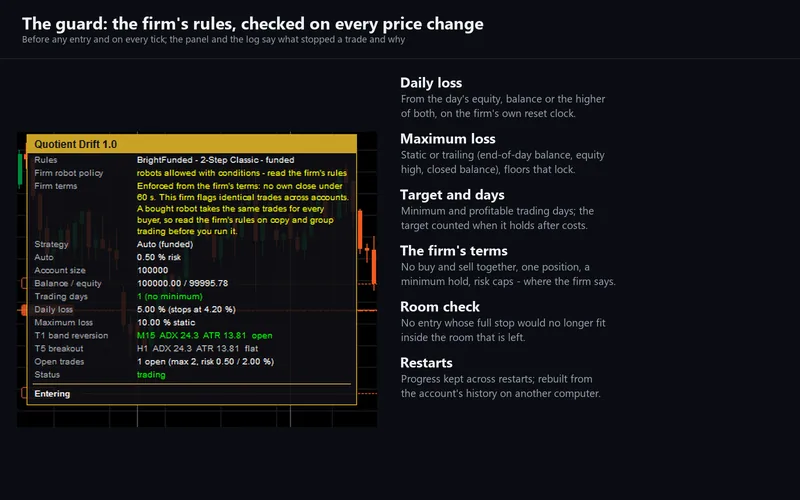
With the Strategy preset on Auto (the shipped default), the risk per trade comes from the room your rules leave: the maximum loss, divided by eight and rounded down to a fixed step between 0.25 and 3 %, with a funded account capped at 0.5 %. The guard measures the daily loss the way the firm does, on the firm's own clock, follows static and trailing maximum-loss floors, counts the target only after the minimum trading days, applies consistency rules, profit and open-loss caps, news and weekend rules where the firm has them, and refuses an entry whose full stop would no longer fit inside the room that is left. A panel on the chart shows the firm, the phase, the risk, the limits, both strategies and the open trades.
The firm's rules and terms
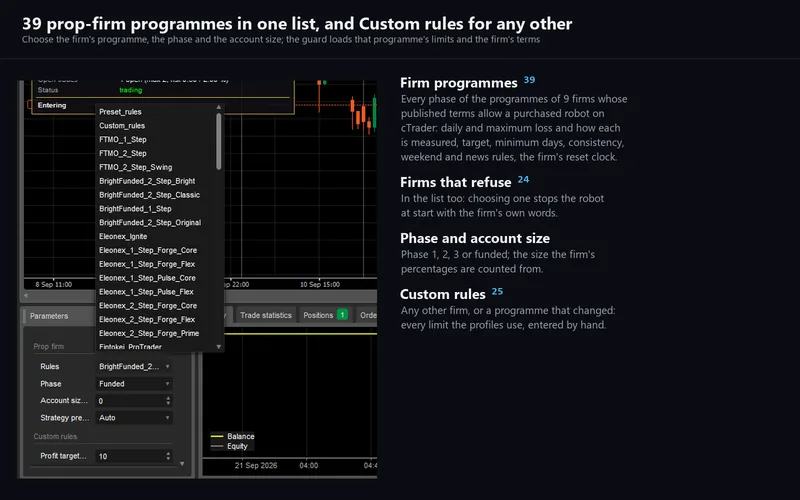
The Rules list holds 39 programme profiles of the 9 firms whose published terms allow a purchased robot on cTrader, phase by phase, and a Custom rules group for any other firm. Where a firm's terms require it, the robot never holds a buy and a sell together, holds one position at a time, keeps each trade open for the firm's minimum time before closing it itself, caps the risk per trade or per day, or counts a trading day only when a trade opens and closes on it; the panel shows which of these apply. The 24 firms whose terms do not allow this robot are in the list too: choosing one stops it at start with the firm's own words. A robot you buy takes the same trades for every buyer, and several firms flag identical trades across accounts as copy or group trading. Quotient Drift does not disguise its trades; read your firm's rules on this before you buy a challenge.
The published backtest
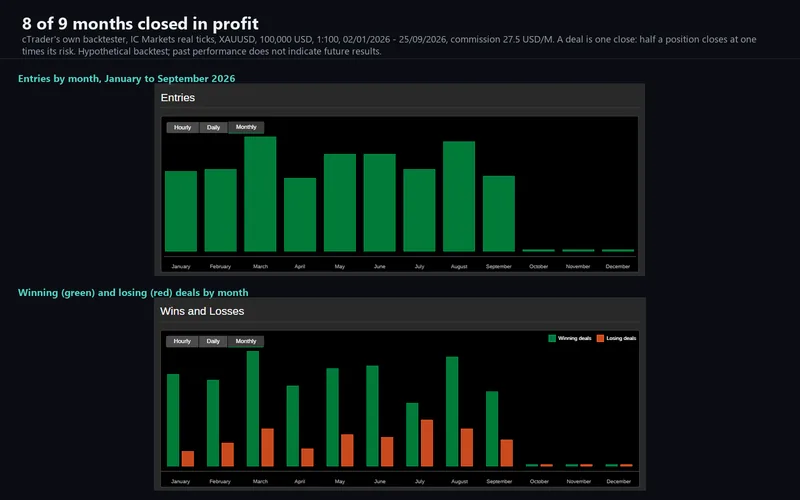
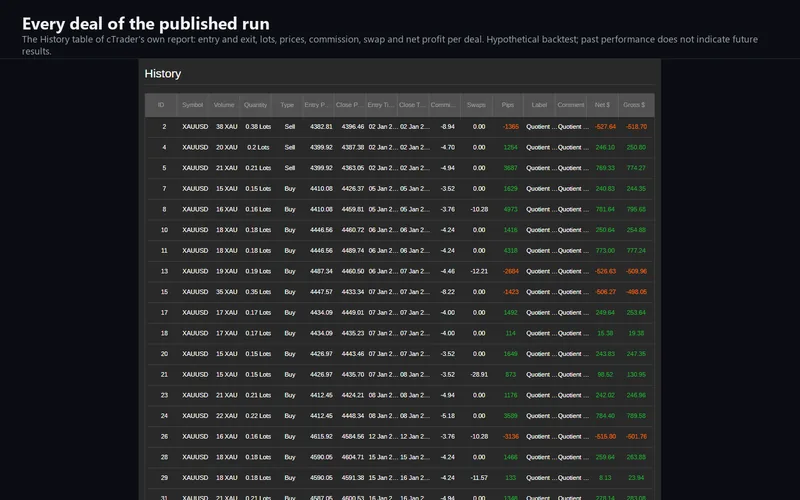
The figures on this page are cTrader's own backtest report of the shipped defaults: a two-step programme's funded phase (5 % daily loss, 10 % static maximum loss), Strategy preset Auto at 0.50 % risk per trade. The run used cTrader's backtester on IC Markets real tick data, XAUUSD, 100,000 USD, leverage 1:100, commission 27.5 USD per million USD of volume, from 2 January 2026 to 25 September 2026. Every number is read from the run's own report file: net profit 34,191.92 USD, a return of 34.19 %, profit factor 1.60, 376 deals of which 285 won, a maximum balance drawdown of 3.23 % and a maximum equity drawdown of 3.49 %, with eight of nine months closing in profit. The same settings on Blueberry Markets real ticks over the same dates gave +26.18 % with a profit factor of 1.49; on a 10,000 USD account, +28.23 %.
What that backtest cannot promise. Auto was tuned on 2026 prices, so this shows how it traded the year it was tuned on; it is not a forecast. In quieter or choppier markets it trades less and earns less. The robot never rounds a lot up: below the broker's 0.01-lot minimum an entry is skipped, which is why the recommended balance is 10,000 USD. The result of any run depends on its period, broker data, balance and leverage; run your own backtest on your own broker's data before trading.
What the challenge simulation shows
Auto was simulated on every firm challenge phase it trades, on real gold ticks of 2026, started from a fresh account on every weekday and judged by the firm's exact limits. Of the starts from January to May, 26 % passed within 14 days, 65 % within 30 days, 84 % within 60 days and 93 % within 120 days, and 0.3 % of the accounts were lost. Of the starts in June and July, only 14 % passed within 30 days and 37 % within 60 days, with about 1.1 % lost. A pass in 14 to 30 days is therefore not reliable across market regimes, the configuration was chosen after all of these months had been seen, and an account can be lost. On the one phase where Auto failed its simulation, the first phase of FTMO's one-step programme, Auto refuses to trade and says why.
How it was verified
The engine is platform-free C#: it references no cTrader type, so the code that ships can be compiled outside the platform and replayed on the same ticks cTrader's backtester uses. Replayed that way, the published run matched cTrader's own report deal by deal, to the cent, with zero mismatches, and the indicators it computes match the reference values bit for bit. Nineteen deliberately planted bugs were each caught by the checks before release, and the guard was started live on a demo account with new entries switched off, stopped, and restarted to confirm it resumes its saved progress. The published figures are cTrader's own, not the replay's.
Presets
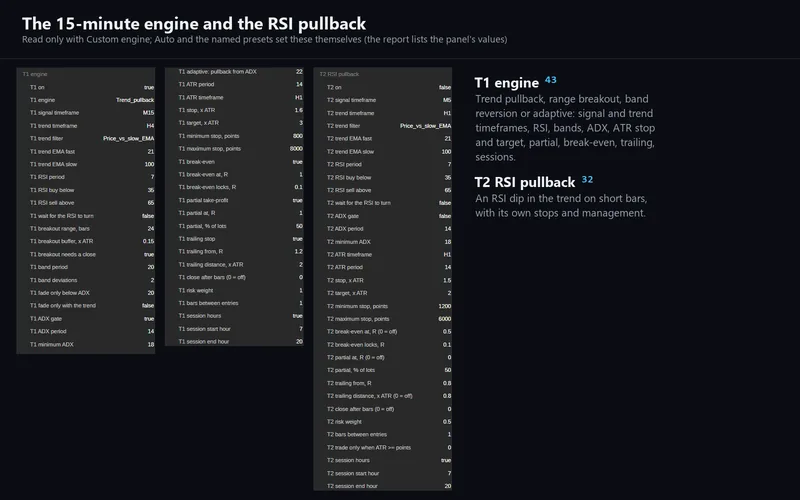
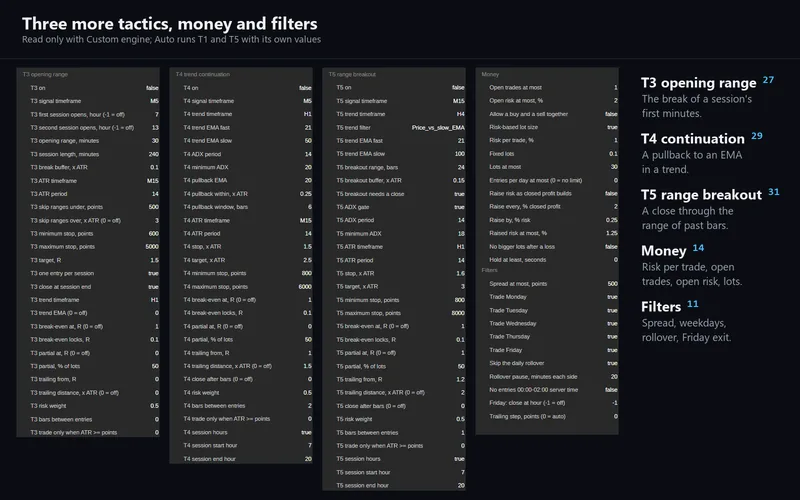
Everything is inside the cBot and chosen with the Strategy preset parameter: Auto, the shipped default; 48 tuned presets of the first band-reversion engine, each named by the rules it was tuned under; and Custom engine, which opens every setting of all five tactics (the 15-minute engine, an RSI pullback, an opening range, a trend continuation and the hourly range breakout). There is no file to download, find or import after the purchase.
Requirements
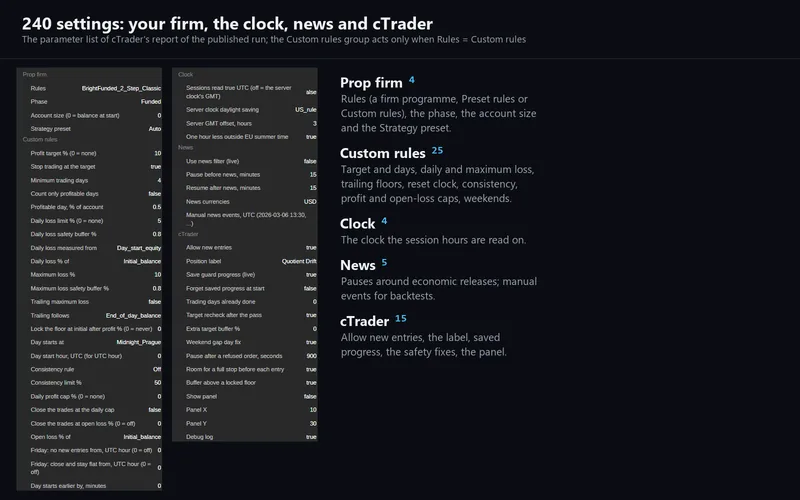
cTrader Desktop 5.x on Windows or Mac, or cTrader Web, on a hedging account (on a netting account it runs only where the firm's terms allow one position at a time); XAUUSD or your broker's spelling of it, on any chart timeframe - it reads its own 15-minute, hourly and four-hour bars. The recommended balance is 10,000 USD. It declares no access rights at all; the news calendar is read through cTrader's own networking service. 240 parameters, every one documented, with a prop-firm guide and the firm rules phase by phase. Keep the platform running, or use a VPS.
Support
Through the Discussion tab of the Store listing, so the conversation stays next to the product. Please include your broker, cTrader version, the firm and phase you chose, your parameter values and the instance log.
This is trading software that places, modifies and closes orders on the account it runs on. Passing a prop-firm challenge is not promised, and neither is a fixed number of days: in the 2026 simulation 0.3 to 1.1 % of accounts were lost, and quiet months passed far slower. Auto was tuned on 2026 prices and earns less in quieter markets. Several firms flag identical trades across accounts; read your firm's rules first. Backtest results are hypothetical; past performance does not indicate future results. Trading leveraged products involves risk of loss.